
Kathryn Milun lets the sun shine for community wealth building
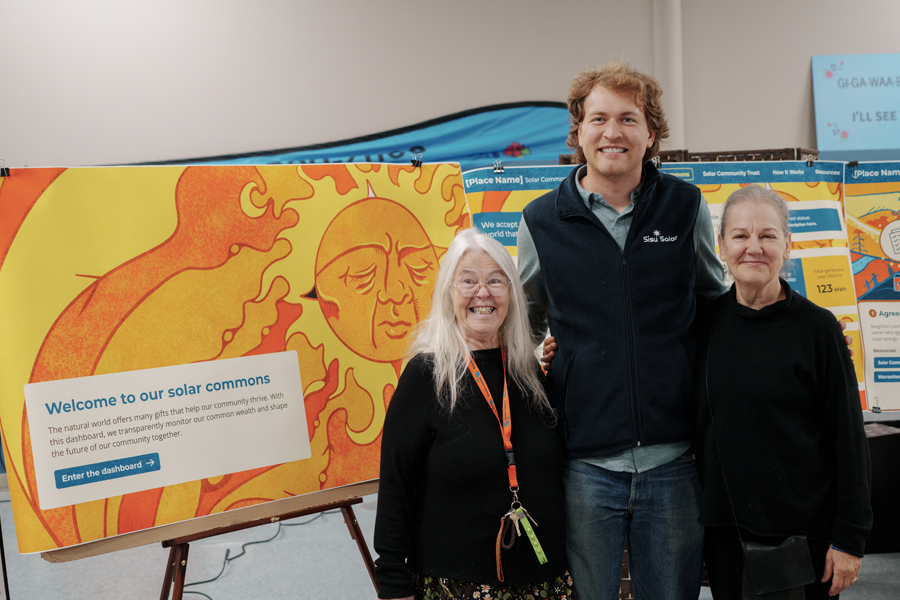
Kathryn Milun (right) with Eric Sipila, engineering graduate of the University of Minnesota and co-owner of the local SISU solar installation company, and Rebecca Gawboy, teacher at the Vermilion Country School.
Kathryn Milun is developing an innovative model that empowers neighbors to fund community-focused projects. Milun, an associate professor and director of the Center for Social Research in the College of Arts, Humanities, and Social Sciences at the University of Minnesota Duluth, co-designed and prototyped the model with low-income, rural, urban and Indigenous communities to shape solar technology to better serve community needs.
The sun shines for everyone
As an anthropologist, Milun has always been interested in how people share things that belong to everyone — like air, water and sunshine. In a time when industrial production has shifted how nature is viewed, owned and managed, she’s working to revive the idea that nature is a gift that can be stewarded and governed locally for local economic benefit.
To do this, she takes a commons-based approach to solar technology. The commons framework sees sunshine as a form of common wealth. Solar Commons use community trusts to ensure that economic benefits of solar energy remain in the decision-making hands of the community.
By the end of a commons year, 12 months of solar electric bill savings are pooled in a community trust fund that is visible on a Solar Commons dashboard. This way, neighbors can use a civic participatory budgeting process to decide what community projects to fund
“I want people to see solar technology as a real, scalable opportunity for communities to claim and locally govern their common wealth from the sun,” Milun says.
Working as one
This summer, Milun and her team established a 40-kilowatt solar commons in Tower, Minnesota, on the southern shore of Lake Vermilion. With funding from the Minnesota Department of Commerce and the University’s Empowering Small Minnesota Communities Program, they installed solar panels on the Vermilion Country School and expect to save $6,000 annually after subtracting system costs.

Researchers and teachers in Tower also created a peer-governance dashboard that transparently monitors the electric-bill savings from the solar technology. Alongside the sun, the dashboard monitors the quality of local air, water and manoomin — the sacred wild rice of the Ojibwe peoples.
Teachers and students will use a citizen science curriculum built by the Solar Commons Research team, analyzing the data they gather on the health of local resources to be good stewards of their local common wealth.
The research team has also designed a Solar Commons Game that the school children play to learn principles of reciprocity between humans and nature. The board game has common wealth tiles for air, water, sun, plants, animals and minerals. Kids draw cards with everyday scenarios and exchange tiles accordingly.
“Public art is an essential part of community education for the Solar Common model,” Milun says. “Art makes abstract ideas of reciprocity, environmental justice, stewardship and community economies visible and tactile.”
The Solar Commons Research Project is guided by the values of a gift economy. In their legal agreement, solar commoners agree to view natural resources as gifts. They promise to use guiding principles of commons — mutual aid and repairing the world — as they decide on what projects to fund from their common wealth gift of sunshine.
Beyond the neighborhood
The Solar Commons Research Project team is currently working with the National Lab of the Rockies to create a manual based on the installation in Tower. It will detail the entire solar commoning process — from cost information, dashboard technology, creating legal agreements and more — all free of charge and open source.

“Projects like this using a commons-based approach show people how new technologies can be designed at community scales for community governance and shared, local economic benefit,” Milun says. “In a moment where climate change and AI are affecting our communities, Solar Commons show that key modern infrastructure can be successfully designed and managed at community scales.”
As she works to incorporate solar commoning into more neighborhoods, Milun is also making plans to scale up the model.
For example, she is working with Heliene, a solar manufacturing firm in Minnesota. Heliene has agreed to install 500 kilowatts of solar panels on its manufacturing center in Mountain Iron and share its projected $60,000 of annual solar savings with local Ojibwe community members building food sovereignty in the 1854 Treaty Area.
Solar commoning can also work for large public sector buildings. In 2023, Duluth campus anthropology students and Twin Cities campus engineering students won first place nationally in the U.S. Department of Energy’s Solar District Cup Collegiate Competition. Under the mentorship of Milun and Uwe Kortshagen, professor in the College of Science and Engineering, the students designed a three-megawatt rooftop solar and battery system for the Twin Cities campus. The design included a 500-kilowatt solar commons carve-out that would generate around $70,000 annually for the community trust from solar savings.
“We’re demonstrating that technology can be designed and owned to better serve humanity. And our University can innovate for commercial, public and local common good,” Milun says.
Learn more about the Solar Commons Research Project.
Festival of the Sun: October 3, 2026


Categories
Campus