
Within the archives: Countless stories and a few unexpected finds
The University of Minnesota Archives are home to millions of documents, photographs, objects and more that tell the story of its five campuses, of Minnesota and of the nation.
Check out some of the more interesting objects and stories preserved in its collections in honor of the University’s 175th anniversary.
Oh deer!
University of Minnesota Crookston Archives

Campus animals are near and dear to many. During the days of the Northwest School of Agriculture, twin deer Don and Don the Second were a joy and a havoc to those in Crookston.
They were a sight to see and quite friendly. A few years later, however, they made Red River Aggie news when they ventured out of the Northwest School Park from morning to mid-afternoon, reportedly keeping students locked down in the dining hall until the deer were safely retrieved.
In search of safe drinking water
University of Minnesota Duluth Archives

In the 1970s, environmental protections rocked northern Minnesota after the discovery of potential cancer-causing microscopic fibers in Lake Superior. The Reserve Mining Company dumped waste rock into the lake for over 20 years, and contaminants spread to Duluth 50 miles away.
Residents needed clean water. Schools and fire stations offered filtered water by the bucketful and those with wells were sharing water with their neighbors. The U.S. government also supplied residents with cartons of drinking water.
The Reserve Mining Company was ultimately found responsible for polluting the lake and was required to use alternative disposal methods.
Pint-sized personality
University of Minnesota Morris Special Collections
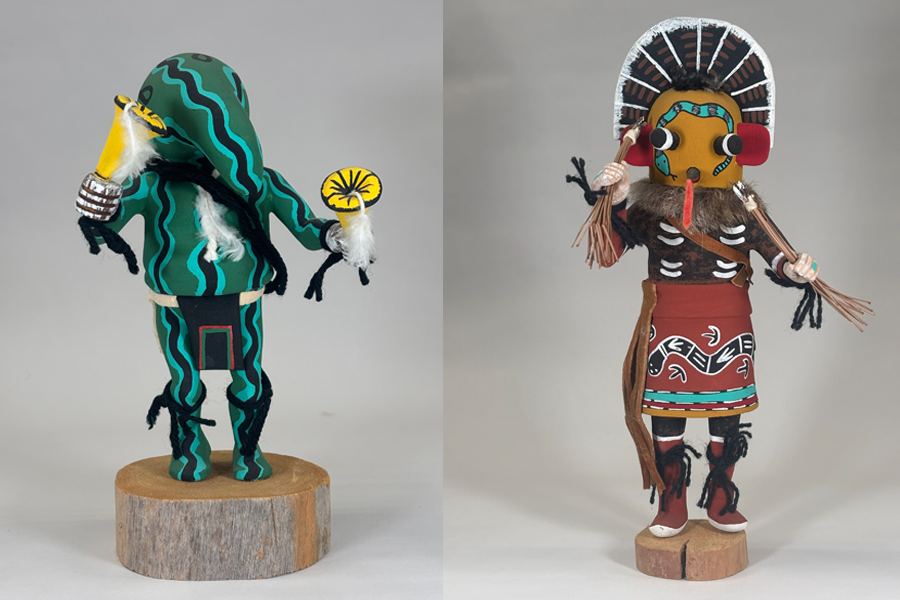
In 2016, Betty and Gershon Gendler donated Indigenous pottery and Katsinas to the Morris campus to support student learning and enrich campus cultural life and beauty. The Gendlers wanted the collection to be used in a campus that understands and appreciates Native cultures.
In spring of 2026, two students gained experience through museum and archival work on Hopi Katsina figurines — wooden carvings that act as messengers between the human and spirit world. They cataloged, researched and managed the dolls, uncovering their more visual purpose rather than ceremonial one. Yet their work has added to the cultural context of modern dollmaking in southwestern Hopi and Pueblo societies.
The figurines are currently on display in Imholte Hall. The Morris campus stewards other special collections, including the West Central Minnesota History Center, along with the campus Archives in Briggs Library.
Twisted beginnings
University of Minnesota Twin Cities Special Collections

The Wangensteen Historical Library of Biology and Medicine has over 8,000 objects representing health, medicine and biological sciences in addition to over 75,000 books. While a catalyst for future inventions, some objects had a macabre start.
During the Middle Ages, the Victorian Siphonia nursing bottle was meant to revolutionize households. The glass or earthenware bottle had a connecting rubber tube for infants to suck and freed mothers from breastfeeding. The tube, however, was difficult to clean, leading to bacterial growth that would sicken its user. The result was an extremely high infant mortality rate and the moniker “Murder Bottle” in the Western world.

In the 18th and 19th centuries, dental care was a bit risky. Tooth keys were a popular tool for extraction by securing it around a tooth and then rotating it to pull it out. Resembling door keys and corkscrew wine openers, the keys were commonly hand-forged by blacksmiths — who also doubled as dentists — and displayed in their shops as signs of craftsmanship and status. Eleven keys are currently in the Wangensteen collection.
Dive into these stories and more in the archives at the Crookston, Duluth, Morris and Twin Cities campuses.
Special thanks to the following faculty and staff for their contributions to this article:
Crookston
- Ashley Helgeson, circulation supervisor and archive assistant, Roger D. Moe Library
- Elizabeth Tollefson, library assistant 2, Roger D. Moe Library
- Keri Yougnstrand, director of library services, Roger D. Moe Library
Duluth
- Aimee Brown, archivist and curator of special collections, Kathryn A. Martin Library
Morris
- Priyanka Basu, associate professor, Division of the Humanities
- Emily Bruce, interim archivist, University of Minnesota Morris Archives
- Naomi Skulan, metadata and technical services coordinator, Rodney A. Briggs Library
- Lisa Walker, marketing and communication specialist, Office of Communications and Marketing
Twin Cities
- Erin Aspinall, director, Health Sciences Libraries
- Emily Beck, curator, Wangensteen Historical Library
- Lois Hendrickson, curator, Wangensteen Historical Library
- Erik Moore, head, University of Minnesota Archives
- Priya Yang, student library assistant, Wangensteen Historical Library
Campus