
Unraveling a nation's hidden history
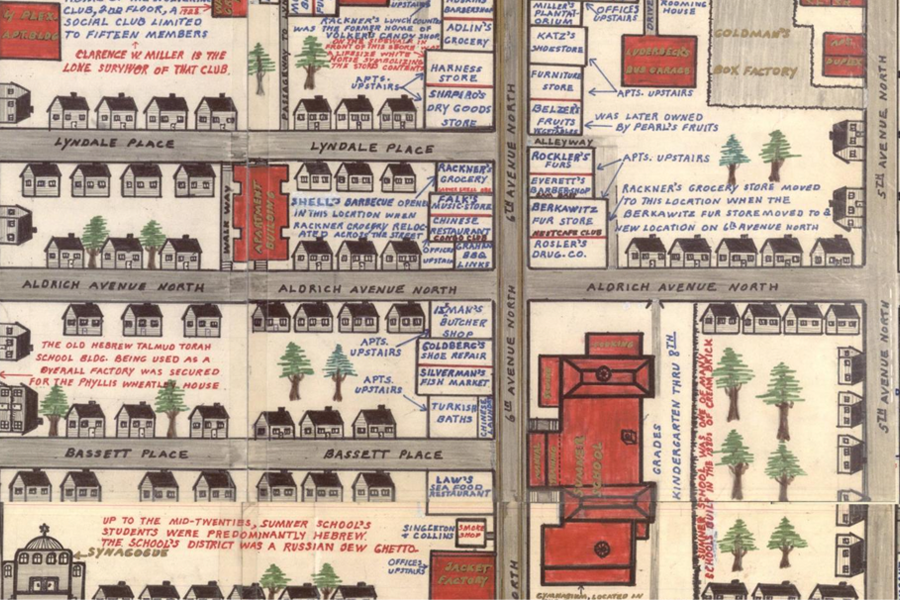
It started with a question about her hometown. How did Minneapolis, a city with such a liberal reputation, develop some of the largest racial disparities in the country? That query led Kirsten Delegard, project director of Mapping Prejudice at the University of Minnesota Libraries, to racial covenants — clauses inserted into property deeds to exclude minority groups from owning or occupying land.
Conversations with Black and Jewish friends introduced her to racial covenants, which had prevented their families from settling in parts of the city with the most public amenities, including her own neighborhood near the beloved Chain of Lakes. This set her on the quest that would become Mapping Prejudice, the first-ever comprehensive visualization of racial covenants for an American city.
The inner workings of Mapping Prejudice
To find and map racial covenants, a University-developed software platform first sifts through millions of pages of property records, flagging documents with suspected racial language. Then, community volunteers take over, confirming that a covenant is real and transcribing key information.

So far, the project has mapped 35,000 racial covenants in Minnesota and 79,000 nationwide, which are readily available for researchers and the public to use in various formats, including spreadsheets, geospatial data and static maps.
However, for Michael Corey, associate director and geospatial, technical and data lead, the power of this project lies in the people uniting to recover historical information and learn about the history of structural racism.
“It becomes real to them in a way that, for so many people, particularly white people, it hasn't been real before. And that is only possible by human interaction,” says Corey.
Empowering community change-makers
Beyond transcribing property deeds, the research team and volunteers discuss the historical context of the documents they’re reading during monthly meetings.

“People across backgrounds are coming together and having these really personal conversations around how this history is impacting them, and they feel empowered to then go out and make change within their own communities,” says Amelia Palacios, communications specialist.
Mapping Prejudice data was used to explain the need for land use reform in Minneapolis, which garnered national attention for eliminating single-zoning. Last year, Mapping Prejudice’s research into Edmund Walton, the real estate developer who introduced racial covenants to Minnesota, inspired grassroots efforts to rename the scenic Edmund Boulevard along the Mississippi River for local civil rights icon Lena Olive Smith.
The work of Mapping Prejudice was also featured in the 2018 Twin Cities Public Television documentary “Jim Crow of the North,” which has been incorporated into K-12 and post-secondary school curricula and civic organization education, and is the most-viewed documentary ever created by Twin Cities Public Television.
In addition to restorative work in Minnesota, the team is going nationwide to help counties gather and analyze their racial covenants.
While the original goal of the project was to map Hennepin County, the team is currently supporting eight active mapping projects in Minnesota, California, North Carolina and Washington, D.C.
What comes next

The momentum of the project continues with the expansion of the map to other areas of Minnesota to deepen knowledge about how racial covenants and segregation look in smaller cities. Their community engagement is also becoming more trauma-informed with the rollout of two new programs mentored by a trauma-informed facilitator for people targeted by racial covenants.
Before Mapping Prejudice, nobody could answer basic questions about racial covenants.
The team credits the University's tools and infrastructure for making it possible to develop granular geospatial data about inequities that pave the way for change.
“We are capable of doing this because everything we do is open access,” says Delegard. “We are radically accessible in everything that we do, and what we've seen is that it has spawned this national collaboration and national field.”
Learn more about Mapping Prejudice.
Categories
Campus