
The University’s 2026 capital request invests in outdated infrastructure, uplifts student success and the state’s future
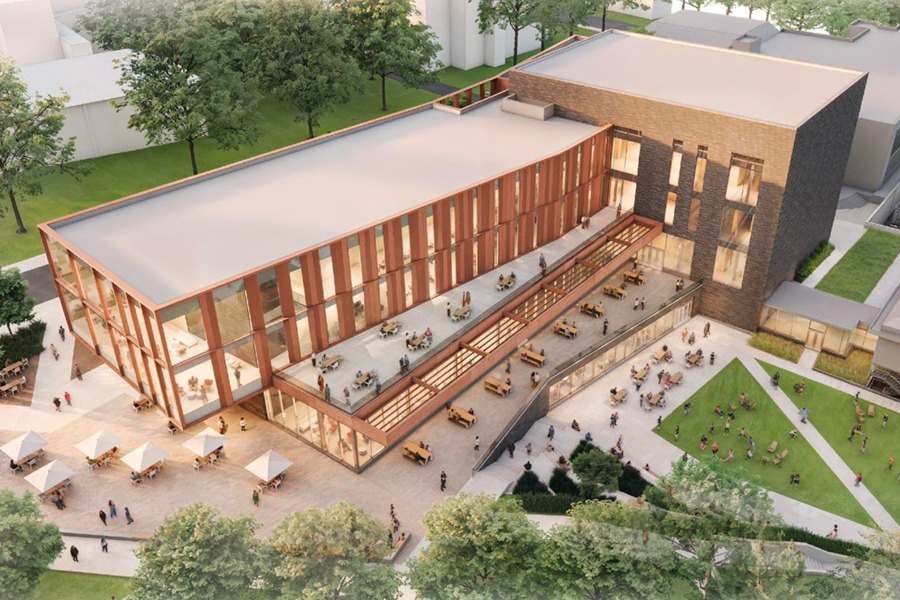
Rendering of the exterior of the St. Paul Campus Center
The University of Minnesota’s ability to prepare students for today’s workforce needs in every industry from hospitals to public schools, along with ground-breaking research that helps fuel the state’s economy, is dependent on critical funds from the state.
To help fulfill its strategic plan and these mission-driven goals, the University submitted its 2026 capital request to the state, which is broken into three parts.
Repairing spaces in poor or critical condition
The first is the University’s $100 million Higher Education Asset Preservation and Replacement (HEAPR) request, which is the most cost-effective investment the University can make in partnership with Minnesota legislators to protect and extend the lifespan of existing facilities.
This funding is vital when nearly one-third (or 8.8 million square feet) of the 30 million square feet across the University are in poor or critical condition. This year's $100 million request is the minimum amount required to keep the $6 billion backlog in needed repairs from growing.

HEAPR focuses on a wide variety of needs including fixing outdated mechanical systems, leaking roofs that hinder energy and sustainability goals, accessible ADA accommodations, such as elevators, and HVAC systems that keep buildings comfortable and safe.
“Our buildings are aging,” says Vice President for University Services Alice Roberts-Davis. “The majority are over 50 years old, and we know that old buildings create new problems.”
Some of these needed repairs across the University include replacing roofs across multiple Crookston buildings, renewing HVAC systems in Duluth’s Humanities building, bringing the Morris Cougar Sports Center into compliance with modern safety and accessibility standards by replacing bleachers and updating lighting and restrooms, and providing extensive code and life-safety improvements for the Twin Cities’ 19-story high-rise, Moos Tower.
Expanding the St. Paul campus’s appeal
A new St. Paul Campus Center will combine new meeting and events spaces, teaching and learning areas, and retail and indoor and outdoor social spaces with student health services and a new St. Paul campus library.

The University is requesting $84 million from the state for this project that is part of a larger revitalization effort on the St. Paul campus, home to a variety of academic programs including agriculture, food science, natural resources, veterinary sciences and human development. This integration of multiple facilities and functions will enable campus-wide building efficiencies and create a dynamic space that drives recruitment, retains students and persuades them to stay in Minnesota post-graduation, strengthening the state's economy.
“We’re bringing new vitality to the center of the St. Paul campus,” says Roberts-Davis. “This space will be a hub for academics, wellness and social connections that’s at the heart of the St. Paul experience for students, faculty, staff and visitors.”
Giving Minnesota even more to smile about
As home to the state's only dental school, the University trains more than 70% of the state's dentists and more than two-thirds of the state’s dental hygienists and therapists, and cares for more than 90,000 dental patients each year.

The University is requesting $100 million in state funding to renovate its dentistry clinics in Moos Tower that are used for clinical education and training spaces to advance the training of dentistry students, better serve patients and operate more efficiently.
“The School of Dentistry significantly impacts the oral and overall health of Minnesotans,” says Keith Mays, dean of the School of Dentistry. “In the Moos Tower clinic, 48% of the patients rely on medical assistance programs, making us one of the largest safety net providers in the state. Renovating the School of Dentistry is an opportunity to transform oral health care for all Minnesotans.”
This project will strengthen the University of Minnesota's recruitment and retention of dental students, as most other Big 10 schools have built state-of-the-art dental teaching and practice facilities within the past decade.
How you can help
To advocate for the University’s 2026 capital request:
- Become a UMN Advocate: Gain knowledge from Government and Community Relations on the legislative process and help shape the outcome by reaching out to elected officials during the legislative session at key times.
- Stay informed on updates across the University related to individual and collaborative efforts to elevate the breadth of student, faculty and staff success.
Categories
Campus