
College of Science and Engineering AI Makerspace provides opportunities for all
The University of Minnesota is advancing its legacy as a nationally and globally recognized leader in artificial intelligence (AI) innovation. This work is vital to unifying the University’s efforts related to AI, advancing leadership in alignment with the Elevate Extraordinary 2030 strategic roadmap.
The College of Science and Engineering (CSE) on the Twin Cities campus does just that with the new AI Makerspace.
Powerful IT and computing resources
Joe Finnegan, AI Makerspace manager, and his staff, made up entirely of students, are centralizing AI information and building resources in the college to make them more accessible.

“We'll have undergraduate students come in with some idea that they want to execute, but they don't have the personal computing power that it would take to do it,” says Finnegan. “We offer them existing University computing services that they otherwise don't get exposed to or have direct access to.”
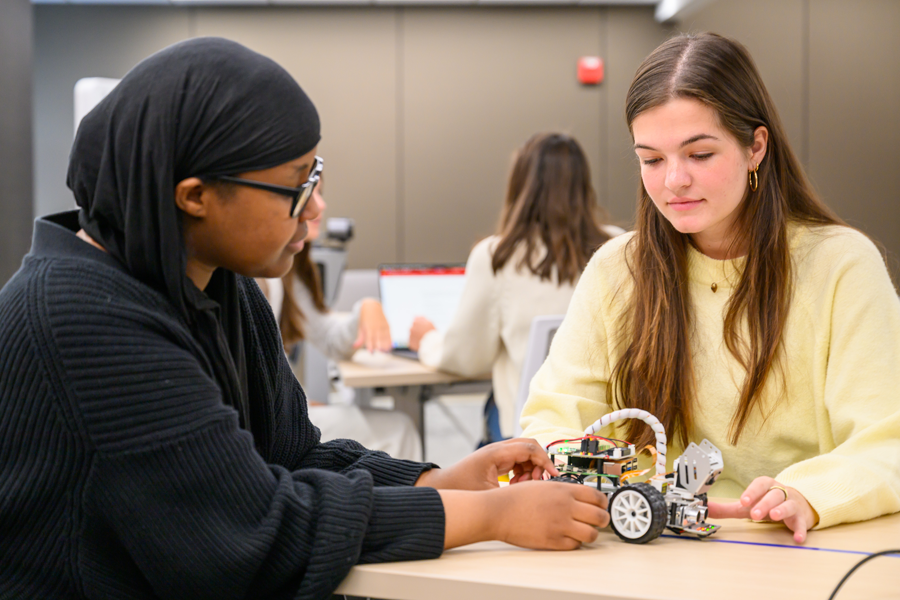
The AI Makerspace is set up for collaboration, featuring whiteboards, video conference tools, and cameras. For computing power, it has advanced NVIDIA machines and desktop computers with strong graphics cards for building and testing local AI models. Users can also access cloud services like Amazon AWS and Microsoft Azure, all for free.
Finnegan finds that the real magic of the AI Makerspace is in the interactions between visitors and student workers.
“They are so plugged in to what's going on in the AI world right now, not just in what they're learning in their academics, but from their own student groups and AI trends,” he says.
A day in the life
The AI Makerspace gives students access to a sandbox environment with research-grade computing hardware coupled with expert guidance from passionate people. Starting a project or joining an ongoing one is as simple as stopping by and submitting a request form. From coding to chatbots or apps, Finnegan and student staff offer support at all stages of a project.

“A lot of students can join research labs and have exposure to some of these methods and the tools, but in those situations, they aren't the principal investigator,” says Finnegan. “But when they come to the AI Makerspace, they are.”
Along with student work, many faculty and staff have connected with the AI Makerspace on internal projects, such as tech tutorials or how to incorporate specific tools in their own instruction and courses.
The AI Makerspace staff are also working to develop Gemini "Gems" for faculty and staff — customizable AI assistants that allow you to give Gemini specific instructions to get tailored responses for repetitive tasks. Currently being piloted is a gem for looking up information in the University Policy Library.
Users are also eager to use AI technology responsibly in conjunction with learning and research. The AI Makerspace hosts educational workshops on AI, including two popular workshops: Introduction to Prompt Engineering and The Responsible Use of AI in Academia and Research.
Growing opportunities
The AI Makerspace expects growing demand for its services as the University’s AI strategy develops.
Along with continued student, faculty and staff support, Finnegan is interested in networking and engaging with alumni and external community partners who want to get involved with AI, but aren’t sure where to get started.
“I see a future in outreach where we're integrating more directly with external business partners and industry because there's a huge demand for AI talent,” says Finnegan. “They are turning to people like undergraduate students and graduate students who are entering the professional world soon.”
The CSE AI Makerspace is located on the first floor of Walter Library and is open to anybody looking to get more familiar with these tools to integrate into their work, research or learning responsibly. Visit their website to learn more.
Categories
Campus