
Forget pineapple on pizza: Researchers at the state fair are tackling a controversial Minnesotan creature
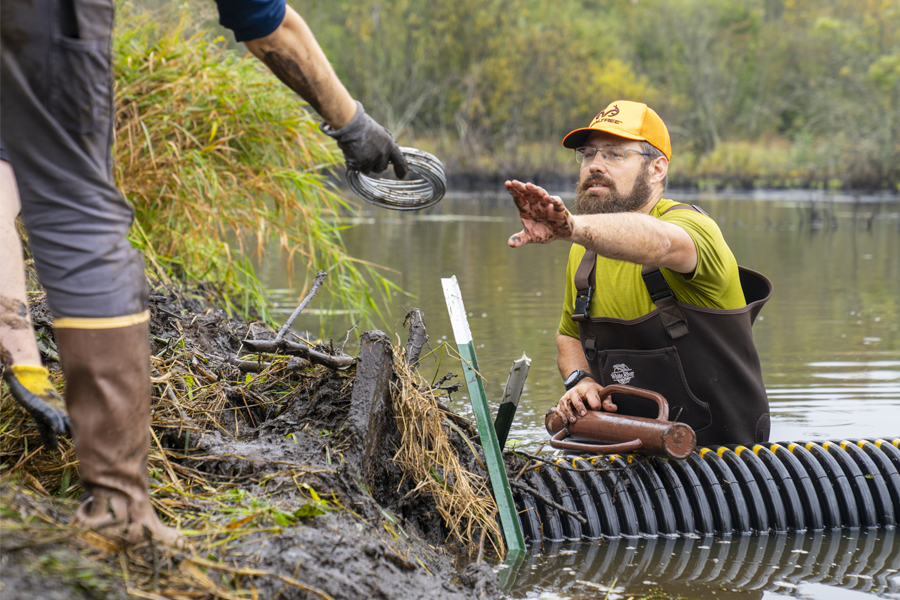
Afton Clarke-Sather installs a device in Duluth’s Hartley Nature Center to allow beavers to remain in the area while keeping water levels low enough to protect the surrounding trails.
Pineapple on pizza, cats vs. dogs, and Marvel or DC are divisive topics, but less talked about is the controversial beaver.
“Beavers mean different things to different people,” says Kyle Smith, a research scientist in the College of Biological Sciences on the University of Minnesota Twin Cities campus. “Some view them as charismatic and cute animals, but others deal with the downsides of interacting with them.”
While they have important ecological benefits, humans can view them negatively when they infringe on their living spaces. This creates a need to determine which beaver conservation strategies will garner the most support from Minnesotans to ultimately improve their opinions of these mammals.
The eco-hero with a habit of flooding basements

North American beavers provide environmental benefits in Minnesota such as creating wetlands that store carbon, improving water quality and protecting communities from flooding, drought and the spread of wildfires.
“For many of these benefits, they do them more cheaply than other engineering systems,” says Afton Clarke-Sather, associate professor in the College of Arts, Humanities, and Social Sciences on the Duluth campus. “They will be better at flood prevention and cost less than an engineer doing it.”
At the same time, beaver activities can damage infrastructure and alter landscapes.
“Beavers can cause flooding in your basement or the road you take to work,” says Clarke-Sather. “Some of the benefits are broad, but negative impacts can be localized.”
Beyond the either-or
To find conservation strategies that will gain Minnesotan support, Smith and Clarke-Sather will survey visitors at the Minnesota State Fair in the University of Minnesota Research Building on September 5 and 6, and share the results with the Minnesota Department of Natural Resources (DNR).

“The main way we’re eliciting data and people’s perceptions is a stated choice experiment,” says Smith. “Instead of directly asking people ‘what’s more important, beaver conservation or flood control,’ it’s an exercise where people are presented with alternatives and rank them from the most to least important to them.”
This will help the wildlife managers learn if they should focus on protecting human-planted trees in local areas, maintaining a large beaver population in an area, allowing beavers to cohabit an area that benefits local fisheries or minimizing the impact of beaver habitat on local parks, for example.
"We often have environmental issues that are conceived of as being either-or choices, but even when people agree, they may do so for different reasons,” says Clarke-Sather. “Some may believe in animal rights, but others may support conservation because beavers help with water quality. So the survey data may also help us determine why that support is there.”
Along with sharing their results with the DNR, Smith and Clarke-Sather expect to do a wider survey in Minnesota or the Upper Midwest for a more representative sample and publish a paper on their findings.
“The hope is that it’s the start of something more,” says Clarke-Sather.
Learn more about the University’s presence at the Minnesota State Fair.
Categories
Campus